Seed Phrase Security: Best Practices for Protecting Crypto Keys

Imagine holding the only key to a vault filled with your life savings. Misplace that key, and everything inside could be locked away forever. In the intriguing world of cryptocurrency, your seed phrase is that unique key – the ultimate master backup for your digital assets. Understanding how to safeguard it isn’t just recommended; it’s absolutely essential for keeping your crypto secure.
What is a Seed Phrase and Why is it So Critical?
Think of a seed phrase—also known as a recovery phrase or mnemonic phrase—as a unique sequence of typically 12 or 24 simple words. These aren’t just random words; they form the master key automatically generated by your cryptocurrency wallet when you first set it up. Should your phone meet an unfortunate end, your computer give up the ghost, or your hardware wallet vanish, this exact sequence of words is usually the only way to regain access to your cryptocurrency.
Holding the seed phrase is effectively holding the cryptocurrency it protects. It’s like knowing the secret combination to an impenetrable safe. Without this phrase, recovering your funds is generally impossible. It acts as the root from which all your individual crypto private keys and addresses within that specific wallet are born.
Where Does My Unique Seed Phrase Originate?
You don’t invent your seed phrase; it’s generated for you. This happens automatically during the initial setup of your chosen cryptocurrency wallet, whether it’s software on your phone or computer, or a dedicated hardware device.
The generation process relies on strong cryptographic principles and randomness, ensuring your phrase is practically unique among countless possibilities. The moment your wallet reveals this phrase, you become its sole guardian. The responsibility to secure it immediately rests entirely on you.
How Does a Seed Phrase Unlock My Crypto (Simplified)?
While the technology behind it is sophisticated, the purpose of a seed phrase is quite straightforward. Consider it a master blueprint. Your wallet uses this specific list of words, in their precise order, along with established mathematical formulas, to generate all the necessary private keys for your various crypto assets.
These private keys are the hidden codes that grant the ability to spend or send your crypto. Your wallet uses them quietly in the background whenever you authorize a transaction. Because seed phrases adhere to widely accepted standards (like BIP-39), if your original wallet software or device fails, you can usually enter your seed phrase into a different, compatible wallet to recover access to your funds. Its primary role is universal key generation for backup and recovery.
Why Typically 12 or 24 Words?
The length of your seed phrase, usually 12 or 24 words, directly impacts its security. Each word is selected from a standardized list containing thousands of possibilities (the common BIP-39 list has 2048 words).
Combining a specific number of words from this extensive list, in a precise sequence, creates an astronomical number of potential unique phrases. Guessing a 12-word phrase through sheer luck is virtually impossible for current computers, and a 24-word phrase offers an exponentially higher level of security against such brute-force attacks. This standardization also ensures different compatible wallets can correctly interpret the phrase.
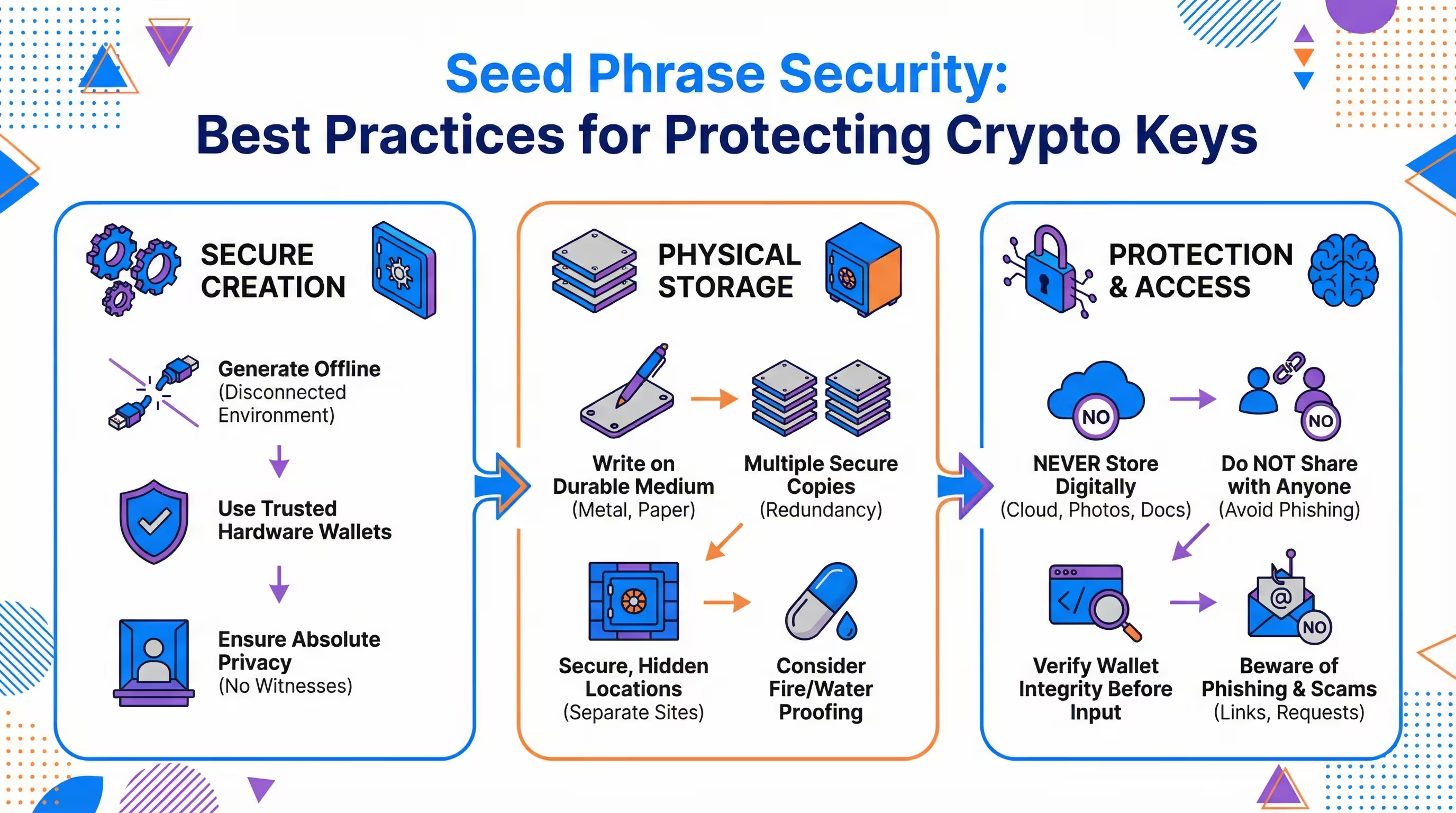
Seed Phrase vs. Private Key vs. Public Key: Simple Differences
These terms often cause confusion for newcomers, but their functions are distinct. Imagine your crypto holdings are like rooms in a secure building:
The Seed Phrase is the master key to the entire building. It’s the ultimate backup that can recreate all other keys if needed.
A Private Key is like the individual key to one specific room (or one crypto asset’s address). It’s the secret code required to access and spend funds from that room, and it’s derived from the seed phrase. You typically don’t handle these directly.
A Public Key is derived from the private key; think of it as the technical specification for that room’s unique mail slot. It’s less visible to the average user.
Finally, the Wallet Address is like the unique public mailing address for that room, derived from the public key. This is the address you safely share with others to receive cryptocurrency.
For practical purposes, you mainly need to secure your seed phrase (for backup) and use your wallet addresses (for receiving funds).
Using a Seed Phrase for Wallet Recovery
Recovery becomes necessary when you lose access to your primary wallet – maybe your phone is lost, your computer crashes, or your hardware wallet fails. The general process involves installing a compatible wallet application on a new device or setting up a new hardware wallet.
During this setup, you’ll specifically look for an option like ‘Restore Wallet’, ‘Import Wallet’, or ‘Recover using seed phrase’, making sure not to choose ‘Create New Wallet’. You will then be prompted to carefully enter your seed phrase words.
Step 1: Install or Initialize
Install compatible wallet software on a new device, or power on and begin setup of a new hardware wallet.
Step 2: Select Restore Option
Choose the menu option explicitly labelled for restoring or importing an existing wallet using a recovery phrase. Avoid creating a completely new wallet.
Step 3: Enter Seed Phrase Carefully
Input your seed phrase words one by one, precisely in the original order they were given. Double-check spelling and sequence meticulously.
Step 4: Regain Access
If entered correctly, the wallet software will use the seed phrase to mathematically regenerate your private keys and corresponding addresses, thereby restoring access to your associated crypto funds.
Absolute accuracy is crucial during input. A single incorrect word or the wrong order will prevent the recovery of the intended wallet.
Why Can’t I Just Reset My Seed Phrase Like a Password?
This is a fundamental concept in the self-custody crypto world. Most popular crypto wallets are non-custodial, meaning you, and only you, control the keys. There isn’t a central company database storing your seed phrase that you can appeal to.
Unlike resetting an email password, where the service provider can verify your identity and send a reset link, there is no “forgot seed phrase” option in decentralized systems. You are the sole key holder.
Important
If you lose your seed phrase and you lose access to the wallet device or app, your cryptocurrency is very likely gone forever. No central authority or customer support team can recover it for you. The responsibility is entirely yours.
What are the Risks if Someone Else Gets My Seed Phrase?
The danger cannot be overstated. Anyone who obtains your correct seed phrase gains immediate, total, and irreversible control over all cryptocurrency assets associated with that phrase. They can transfer every single coin and token to their own address instantly, without needing your permission or access to your device.
Warning
Transactions on most blockchains are final and irreversible. Once a thief uses your seed phrase to steal your funds, there is practically no way to retrieve them. The seed phrase alone is enough to drain your accounts.
This immense risk applies to every type of crypto held within the wallet generated from that specific seed phrase.
How Do Scammers Attempt to Steal Seed Phrases?
Scammers use cunning methods to trick people into revealing their precious seed phrases. Stay extremely alert for these common tactics:
Phishing Scams: Be wary of emails, direct messages, or websites impersonating legitimate crypto platforms, wallet providers, or technical support. They often create fake urgency, claiming your account needs verification or has a security issue, directing you to enter your seed phrase on a fraudulent site or form.
Malware Infections: Malicious software like keyloggers or spyware can infect your computer or smartphone. Keyloggers silently record everything you type, potentially capturing your seed phrase. Other malware might scan your files or clipboard contents for phrases stored insecurely.
Fake Support Personnel: Imposters often monitor public forums, chat groups (like Telegram or Discord), or social media comments. They might pose as official support staff offering help with a wallet problem, eventually asking for your seed phrase to “diagnose,” “sync,” or “fix” the non-existent issue.
Fraudulent Apps and Extensions: Only download wallet software or browser extensions from official websites or app stores. Malicious copies exist that look identical to legitimate ones but are designed solely to steal any seed phrase entered.
Social Engineering Ploys: Sometimes scammers engage in conversation, build rapport and false trust, then subtly manipulate you into revealing your phrase through seemingly innocent questions or requests for “help.”
Caution
Legitimate companies, wallet developers, or support teams will NEVER ask for your seed phrase under any circumstances. Anyone requesting it is almost certainly attempting to scam you. Never share it.
Where Should I Store My Seed Phrase Securely Offline?
The most recommended method for seed phrase security is offline storage, often called “cold storage,” meaning it’s completely disconnected from the internet. This drastically minimizes the risk of online hacking or malware theft.
A basic and effective method is to carefully write down the phrase on high-quality paper. Ensure your handwriting is legible, words are spelled correctly, and the sequence is exact. Numbering each word (1 to 12 or 1 to 24) is also wise.
For greater resilience against physical hazards, consider specialized metal seed storage devices. These often involve engraving, stamping, or arranging metal tiles within a robust casing, providing significant protection against fire and water damage compared to paper.
Store your physical backup(s) in extremely secure, private locations. Think of a high-quality fireproof safe at home, or potentially a bank safety deposit box (though consider accessibility constraints and potential institutional risks). Using multiple secure locations for redundancy is a good strategy. Always think about physical threats: fire, flood, theft, pests, ink fading, or even someone accidentally discarding it.
Are Metal Seed Storage Plates a Worthwhile Investment?
Metal storage solutions—plates, capsules, or jigs where you physically record your seed words onto metal—offer one clear benefit over paper: durability. They are engineered to withstand physical damage like fire, water immersion, and corrosion far better than paper or laminated cards.
However, they have downsides. They are more expensive than paper and pen, require some care and effort to record the phrase accurately onto the metal, and crucially, they still need to be stored securely. A metal plate left unsecured is just as vulnerable to theft or discovery as a piece of paper. They improve physical resilience but don’t eliminate the need for secure placement and secrecy.
Is Storing My Seed Phrase Digitally Ever Safe?
As a general guideline, especially for those new to crypto, storing your complete seed phrase digitally on any internet-connected device (computer, phone, cloud storage) is strongly advised against. The potential risks are simply too significant.
Caution
Digital storage makes your master key vulnerable to hacking, malware that scans files or clipboards, device theft or loss, security breaches affecting cloud services (like Google Drive, Dropbox, iCloud Notes), and even accidental deletion.
While more technically advanced users might explore options like storing phrases within heavily encrypted files on offline devices, using dedicated encrypted partitions, or specialized offline password managers, these methods require deep technical understanding and introduce their own failure points (like forgetting the encryption password). For most users, robust offline, physical storage remains the significantly safer and more straightforward approach.
What Common Mistakes Lead to Seed Phrase Loss?
Many devastating crypto losses result from simple errors in handling seed phrases. Be sure to avoid these frequent mistakes:
Never take a screenshot or photograph of the seed phrase when it’s displayed on your screen during wallet setup. Avoid emailing the seed phrase to yourself or storing it in unsecured digital notes or documents (like standard notes apps or word processor files).
Do not save the phrase as a plain text file on your computer or phone. Refrain from storing the full phrase directly within a conventional password manager; while convenient, if the manager itself is compromised, your master key is exposed.
Critically, never share your phrase, in whole or part, with anyone – this includes friends, family, and especially anyone online claiming to offer support. Storing the physical backup carelessly where it might be easily found, mistaken for trash, or damaged by spills or humidity is another common failure.
Be vigilant about never entering the phrase into suspicious websites, unexpected pop-up windows, or unverified mobile apps. Lastly, a crucial error is failing to verify the accuracy of your written backup immediately after creating it; check spelling and order meticulously.
Should I Make More Than One Backup Copy?
Yes, creating multiple physical backups is strongly recommended for redundancy. Having at least two, ideally three, distinct copies significantly mitigates the risk if one is lost, stolen, damaged, or destroyed.
Consider storing these backups in different, highly secure, geographically separate locations if feasible and safe for your situation. For instance, one copy might reside in a robust home safe, another perhaps in a bank safety deposit box, and maybe a third securely sealed and entrusted to a highly reliable person (fully understanding the trust implications). Remember, each backup copy is as sensitive as the original and requires the same level of stringent security.
How Can I Confirm My Seed Phrase Backup is Correct?
Verifying your backup’s accuracy is essential, and the best time to do it is immediately after writing it down, ideally before sending any significant amount of crypto to the wallet.
First, carefully compare your written copy word-for-word against the phrase displayed by the wallet during its setup process. Check every letter of every word and confirm the exact sequence. Many wallets integrate a verification step where you must re-select or re-type the words in order, confirming you’ve recorded them correctly.
Tip
For added assurance, some experienced users perform a controlled test recovery. After ensuring the wallet is empty or holds only a tiny, negligible amount, they might wipe the wallet software or reset the hardware device. Then, they attempt to restore access using only their written backup. Success confirms the backup is accurate and functional. If this sounds too risky, meticulous double-checking during the initial recording is paramount.
What is a Seed Phrase Passphrase (13th/25th Word)?
A passphrase, sometimes referred to as the “13th word” (for 12-word seeds) or “25th word” (for 24-word seeds), is an optional, advanced security feature built into the same BIP-39 standard used for seed phrases. It’s essentially a custom word, phrase, or string of characters that you create and choose to add on top of your standard 12 or 24-word seed.
Importantly, using a passphrase doesn’t merely add a password to your existing wallet. It mathematically combines with your original seed phrase to generate a completely new, distinct, hidden wallet. Your original 12/24 words alone will still recover a different wallet (which would be empty unless you used it before enabling the passphrase). The passphrase acts as a required second factor to access the specific hidden funds.
Should Beginners Use This Optional Passphrase Feature?
Passphrases provide a powerful security enhancement. If someone were to steal your physical 12 or 24-word seed backup, they still couldn’t access the funds protected by the passphrase unless they also knew your exact, secret passphrase.
However, this advanced feature introduces a significant risk:
Warning
If you forget your custom passphrase – even a single character difference, as it’s case-sensitive – the cryptocurrency in the hidden wallet linked to that seed + passphrase combination is permanently and irretrievably lost. There is absolutely no recovery mechanism for a forgotten passphrase. Even with the correct 12/24 word seed, the funds in that specific hidden wallet are gone forever.
Due to this high risk of irreversible loss from forgetting, beginners are generally advised to avoid using passphrases until they are fully confident and disciplined in securely managing their standard seed phrase. If you choose to use one, you must back up the passphrase with the same (or even greater) diligence as the seed phrase itself, but store it separately from the seed phrase backup to maintain the security benefit.
Seed Phrases and Hardware Wallets
Hardware wallets (physical devices like those from Ledger or Trezor) are purpose-built for enhanced security. They generate your seed phrase directly on the secure, offline device during the initial setup. You’ll typically write down the phrase shown on the device’s screen.
This seed phrase acts as the vital backup for the hardware wallet. If your device breaks, is lost, stolen, or needs resetting, you use this seed phrase to restore your accounts onto a new, compatible hardware wallet. A core security principle is that during normal use, the seed phrase (and the private keys it generates) should never leave the device’s secure internal chip. Nevertheless, backing up the generated seed phrase securely offline remains just as crucial as with software wallets.
Seed Phrases and Software/Mobile Wallets
Software wallets are applications running on your computer or smartphone (examples include Exodus, MetaMask mobile, Trust Wallet). They also generate a seed phrase when you first create a wallet.
This phrase is your master backup. If you lose your phone, your computer fails, or you uninstall the app, you need this seed phrase to reinstall the wallet on another device and restore access using the recovery process outlined earlier. The key security difference is that software wallets operate on internet-connected devices. This makes the seed phrase potentially more exposed to online threats like malware or phishing, especially during the setup process when it’s displayed on screen. Therefore, writing it down immediately and securing it offline is absolutely vital.
What If I Lose My Seed Phrase Backup?
Let’s be perfectly clear: if you use a non-custodial wallet (where you control the keys), and you lose your seed phrase backup, and you subsequently lose access to the original wallet application or device (e.g., phone breaks, app deleted, hardware wallet lost), your cryptocurrency is almost certainly lost forever.
Important
In the world of self-custody crypto, there’s no central company, bank, or support desk that can magically recover your funds if you lose your master key – the seed phrase. It’s the digital equivalent of burying treasure and losing both the map and the key. Without them, the treasure remains locked away, inaccessible.
Long-Term Seed Phrase Storage Considerations
Securing a seed phrase for many years requires careful thought. Consider the durability of your backup medium: standard paper can degrade, tear, or fade, especially in damp environments. Metal storage offers far superior longevity against physical damage.
Think about environmental risks: is your chosen storage location protected from potential fire, flooding, extreme temperatures, or pests? Also, evaluate location security: how well is it protected against theft, unauthorized viewing by others, or accidental disposal by someone unaware of its value?
Briefly consider future access: how might a trusted person securely access the phrase if necessary years down the line (this touches on inheritance planning concepts, but seek professional legal/financial advice for specifics)? Finally, periodically checking the physical condition and security of your backup (perhaps every few years) is prudent, especially if using paper.
The Single Most Important Rule for Seed Phrase Safety
If you remember only one thing, let it be this: Never, ever share your seed phrase with anyone, website, or application you do not have 100% verified trust in. Never store it digitally in an unencrypted or easily accessible format.
With non-custodial crypto wallets, you effectively operate as your own bank. This grants you control but also assigns you the ultimate responsibility. Your seed phrase is the master key to your financial sovereignty in the crypto realm. Guarding it diligently is the bedrock of securing your assets. It truly embodies the crypto principle: “Not your keys, not your coins.”
Note
The information provided in this article is for educational and informational purposes only. It does not constitute financial, investment, legal, security, or tax advice. Cryptocurrency investments involve significant risks, including the potential for total loss of funds. You are solely responsible for conducting your own research, understanding these risks, and securing your assets appropriately based on your individual circumstances and risk tolerance. Always verify information from multiple trusted sources before making any decisions related to cryptocurrency.